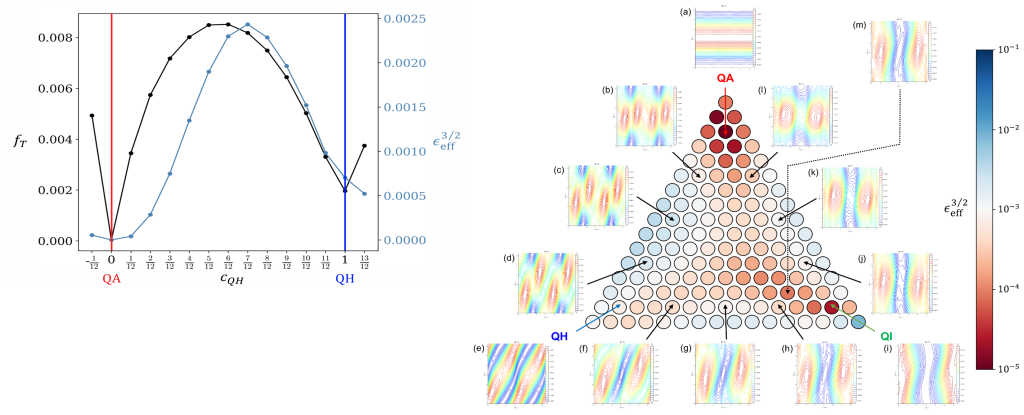
The Stellarator Optimization Group leads core efforts within Korea’s emerging stellarator research program, advancing modern optimization techniques and integrated modeling frameworks for next-generation fusion devices. We develop optimized stellarator configurations using state-of-the-art tools—DESC, VMEC, FOCUS, and REGCOIL—and pursue a flexible stellarator concept capable of accessing multiple quasi-symmetry families, enabling direct configuration-to-configuration comparisons and systematic validation of the underlying physics. In parallel, we design and optimize three-dimensional modular coil systems to realize physically robust and engineering-feasible magnetic geometries.
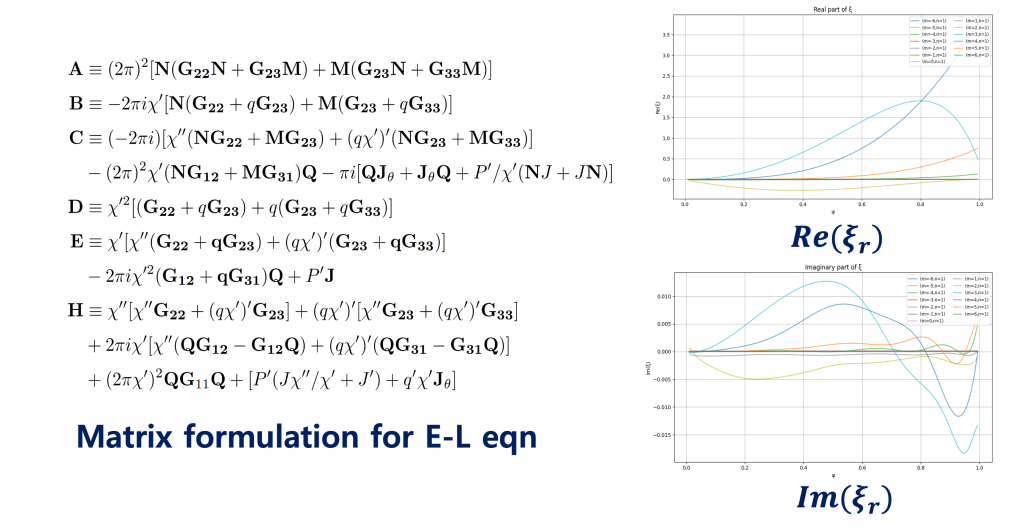
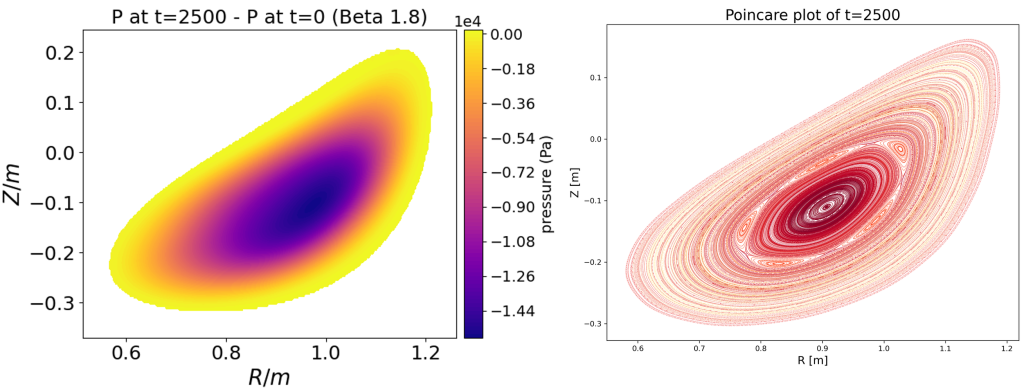
Building on equilibrium theory, we extend perturbed-equilibrium methodologies—originally formulated for tokamaks—to fully three-dimensional stellarator systems, allowing accurate evaluation of force balance, linear stability, and the sensitivity of magnetic structures to small perturbations. In parallel, we are developing advanced stability analysis tools such as 3D DCON and 3D GPEC to assess ideal and resistive MHD stability in optimized configurations. High-fidelity nonlinear MHD simulations with M3D-C1 further enable us to examine the self-consistent behavior of high-β equilibria and investigate magnetic-island formation and other global stability limits.
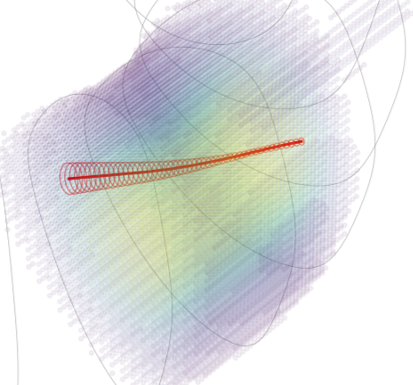
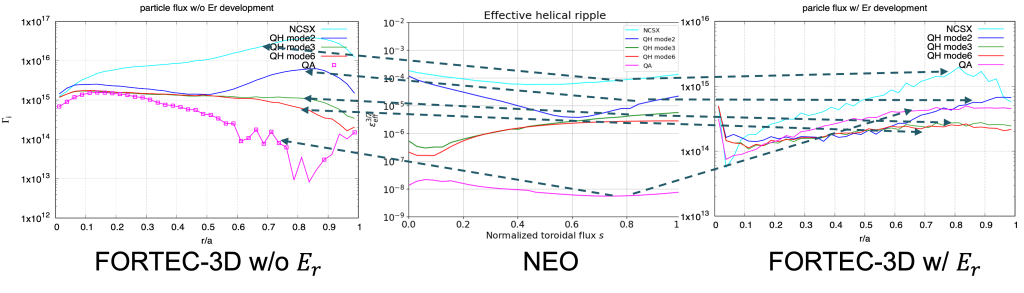
Global 3D neoclassical transport simulations using FORTEC-3D complement these efforts by providing quantitative predictions of particle and heat transport, fully incorporating ambipolar electric fields and finite-orbit-width physics essential in low-collisionality stellarator plasmas.In addition, we are developing a three-dimensional beam tracing code to model wave and beam propagation in complex stellarator geometries, enabling more realistic assessments of heating, current drive, and diagnostic accessibility.
Together, these capabilities form an integrated, multi-physics framework spanning equilibrium, stability, transport, coil engineering, and wave physics, supporting the design, validation, and performance optimization of advanced stellarator concepts.
Plasma evolution through current control (Quasi-Axisymmetric configuration to piecewise-Omnigenous configuration)
Sensitivity of Quasi-Symmetry in stellarator equilibria
3D DCON development
3D beam tracing code development
Effect of radial electric field in neoclassical transport